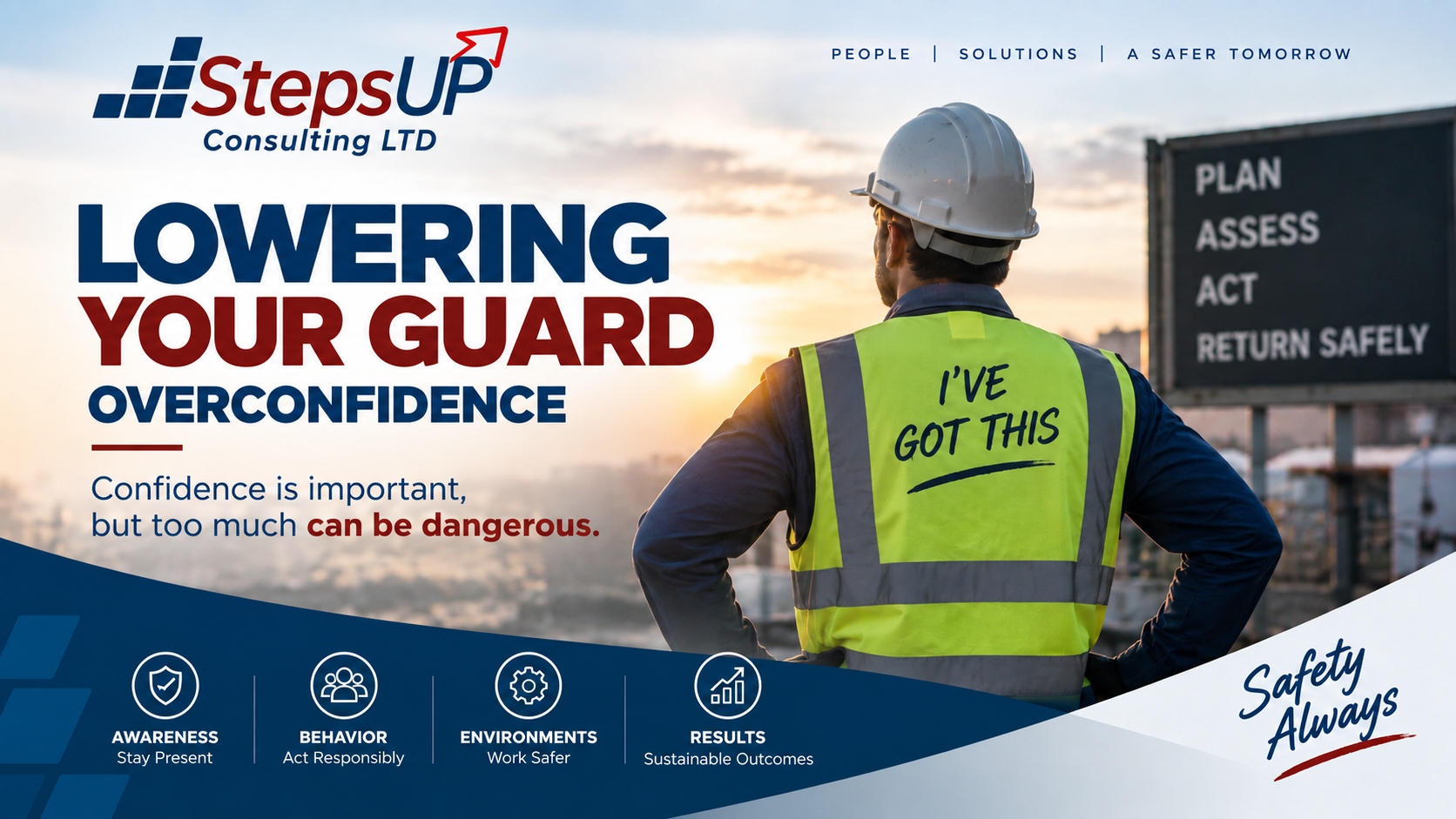
Overconfidence: When Experience Makes Us Lower Our Guard
Confidence is important in the workplace. It allows us to perform our tasks effectively, develop our skills and make decisions based on experience. However, when confidence turns into overconfidence, we may begin to underestimate hazards, skip procedures or assume that nothing will go wrong.
Many unsafe situations begin with seemingly harmless thoughts such as: “I’ve done this before,” “This is easy,” “It will only take a minute” or “Nothing has ever happened.”
Experience reduces uncertainty, but it never eliminates hazards.
Staying alert, even during familiar and routine tasks, is essential to preventing incidents, injuries and damage.
What Is Overconfidence?
Overconfidence occurs when we feel so certain about our skills, knowledge or experience that we begin to lower our guard around workplace hazards.
This can lead us to skip important steps, ignore warning signs or perform a task without applying all the required safety measures.
Common signs of overconfidence include:
- Believing that following every step of a procedure is unnecessary.
- Relying only on previous experience.
- Performing a task automatically without reassessing the risks.
- Ignoring small changes in the work environment.
- Taking shortcuts to complete a task faster.
- Assuming equipment will work properly because it has never failed before.
Confidence is positive. Overconfidence can become a hazard.
Why Is Overconfidence Dangerous?
When we perform the same task repeatedly, it can begin to feel simple, predictable and completely under control.
That familiarity can reduce our perception of risk.
Overconfidence can lead us to:
- Underestimate workplace hazards.
- Skip important inspections or checks.
- Fail to use personal protective equipment correctly.
- Take unnecessary shortcuts.
- Work too close to equipment or hazardous areas.
- Ignore changes in workplace conditions.
- Continue working even when an unsafe condition is present.
A task may have been completed one hundred times without an incident and still present a hazard the next time it is performed.
The fact that an accident has never happened does not mean the risk does not exist.
How Does Overconfidence Show Up?
Overconfidence is not always obvious. It often appears through small decisions and behaviors during everyday work.
Examples include:
- “I’ve done this many times.” Experience can create a false sense of complete control.
- “This is easy.” Even simple tasks can involve serious hazards.
- “I don’t need to review the procedure.” Procedures exist to help control known risks.
- “It will only take a minute.” Many incidents occur during quick or seemingly minor tasks.
- “I don’t have time.” Time pressure can cause important safety steps to be skipped.
- “Everyone else does it this way.” A common practice is not necessarily a safe practice.
Recognizing these thoughts can help us stop before making an unsafe decision.
A moment of overconfidence can change everything.
Common Situations Where Overconfidence Can Appear
Overconfidence can occur during any activity, but certain situations require additional attention.
- Routine tasks: performing the same activity every day can make hazards seem less significant.
- Greater experience: knowing a task very well can create the perception that all risks are completely controlled.
- Time pressure: rushing to finish a task can lead to shortcuts and skipped steps.
- Familiar equipment: assuming that a machine or tool will always behave the same way.
- Influence of others: repeating unsafe practices simply because other workers do the same.
- Changes in the environment: even small changes can introduce new hazards into a familiar task.
Our experience is valuable, but caution should always go with it.
Real Consequences of Overconfidence
A small unsafe decision can have consequences that extend far beyond the person performing the task.
Possible consequences include:
- Injuries to ourselves or others.
- Damage to tools, equipment and facilities.
- Delays or interruptions in operations.
- Additional costs for the organization.
- Loss of trust within the team.
- Negative impact on the safety culture.
Incidents can also affect co-workers, families, customers and the continuity of operations.
Carelessness can have a cost.
How to Avoid Overconfidence
Prevention begins by recognizing that no task is completely free of risk.
Even with years of experience, we should maintain a learning mindset and continuously assess our surroundings.
Good practices include:
- Follow procedures: never skip steps simply because a task seems easy or familiar.
- Identify the risks: reassess the work area before beginning the task.
- Keep a learning mindset: experience does not mean we know everything.
- Listen to your team: someone else may identify a hazard you have overlooked.
- Act with care: avoid unnecessary improvisation and shortcuts.
- Inspect your equipment: never assume a tool is safe simply because it worked correctly before.
- Stop when conditions change: a different condition requires a new assessment.
Safety is an attitude we practice every day.
Safe Pause: Think Before Acting
Taking a few seconds to analyze the situation before starting a task can prevent incidents, injuries and damage.
A simple approach is the POPA method:
- Pause: stop for a moment. Ask yourself whether it is safe to begin.
- Observe: analyze your surroundings, identify the hazards and consider what could go wrong.
- Ask: clarify your doubts. Confirm that you have the right equipment, information and support.
- Act: proceed only when the task can be performed safely and according to established procedures.
This pause may take only a few seconds, but it can completely change the outcome of a task.
A moment of pause today can prevent a big problem tomorrow.
Report Unsafe Conditions and Near Misses
A strong safety culture also depends on communicating situations that could lead to an incident.
We should not wait until someone is injured before taking action.
Report conditions such as:
- Procedures that are not being followed correctly.
- Unsafe tools or equipment.
- Shortcuts that have become common practice.
- Changes in workplace conditions.
- Hazards that other workers may not have noticed.
- Near misses related to rushed decisions or overconfidence.
Near misses provide an opportunity to learn and correct a problem before more serious consequences occur.
Identifying and reporting a hazard today can prevent an incident tomorrow.
StepsUP – Safety Moment: Overconfidence
For a visual summary of overconfidence, its warning signs, common situations, real consequences and preventive actions, review the StepsUP Safety Moment:
StepsUP Safety Moment – Overconfidence
Review the complete presentation on overconfidence, including how to recognize it, why it can be dangerous, common situations, real consequences, preventive actions and the importance of taking a safe pause before acting.
This Safety Moment can be used during toolbox talks, team meetings, orientations, training sessions or pre-task discussions to reinforce the importance of staying alert and preventing routine or experience from causing us to lower our guard.
Experience Never Replaces Caution
Safety is not just a set of rules. It is an attitude we practice every day.
Experience helps us work more effectively, but it should never cause us to ignore hazards. Before starting a task, observe your surroundings, identify what could go wrong, follow established procedures and listen to your team.
If conditions change, stop and reassess the situation.
Pause. Observe. Ask. Act safely.
Small actions can make a big difference.
Safety today builds a better tomorrow.