Situational Awareness: How to Identify Risks and Prevent Incidents
Safety begins with our ability to observe, understand, and anticipate what is happening around us.
Whether at work, while traveling, in industrial facilities, public spaces, or during field activities, conditions can change unexpectedly and create potentially dangerous situations.
Moving vehicles, operating machinery, uneven surfaces, distractions, and environmental changes are factors that require constant attention.
Developing strong situational awareness helps individuals recognize hazards early, make informed decisions, and take preventive action before an incident occurs.
Being aware of your surroundings is not just a safety measure. It is a responsibility that protects your life and the lives of those around you.
What Is Situational Awareness and Why Does It Matter?
Situational awareness is the ability to identify what is happening in your surroundings, understand how it may affect your activities, and anticipate potential changes or threats.
It involves more than simply looking around. It requires actively recognizing and evaluating environmental conditions.
Being aware of changing conditions helps prevent incidents on roads, in facilities, offices, operational areas, and public spaces.
Key benefits include:
- Early hazard identification: Recognize unsafe conditions before they lead to accidents.
- Better decision-making: Evaluate situations and select safe, timely actions.
- Incident prevention: Reduce unnecessary exposure to hazards in the surrounding environment.
- Effective communication: Promptly report hazards that may affect coworkers and other individuals.
- Greater preparedness: Identify exit routes, safe alternatives, and appropriate emergency response procedures.
Prevention begins when we recognize a hazard before it becomes an accident.
Three Essential Elements of Situational Awareness
Maintaining situational awareness requires three essential skills: observing, understanding, and anticipating.
1. Observe: Identify What Is Happening Around You
Pay attention to the conditions of your surroundings and recognize anything that could create a potential hazard.
Important factors to monitor include:
- Movement of vehicles and machinery.
- Presence and movement of people.
- Condition of walking surfaces and work areas.
- Access routes, exits, and evacuation pathways.
- Safety signs, warnings, and restricted areas.
- Environmental changes and unexpected conditions.
2. Understand: Evaluate Potential Risks
Observing is important, but understanding what you see is equally essential.
Consider how surrounding conditions may affect your activities and personal safety.
For example, a vehicle parked near a work area may become a hazard if it unexpectedly begins moving.
Recognizing this possibility allows you to maintain a safe distance and take preventive measures.
3. Anticipate: Prepare for Potential Changes
Think about what could happen if current conditions change.
Identify safe alternatives, possible exit routes, and the actions required to respond to a developing hazard.
Situational awareness is a continuous habit, not a one-time inspection.
Preventive Measures to Strengthen Workplace Safety
Staying alert requires practical actions that can be applied across different work environments.
Before Starting an Activity
Conduct a brief assessment of the work area, identify existing hazards, and confirm that emergency exits are accessible.
Verify that equipment, tools, and procedures are appropriate for the task.
While Performing the Task
Avoid unnecessary distractions, remain focused on your activities, and continuously monitor changes in your surroundings.
Take appropriate breaks when necessary and communicate safety concerns with coworkers.
When Conditions Change
If you identify an unexpected or potentially dangerous situation, stop the activity when it is no longer safe to continue.
Notify the appropriate personnel and reassess the conditions before resuming work.
Always follow established workplace safety procedures and report unsafe conditions.
Safe Work Practices: Before, During, and After
Situational awareness should be an essential part of every stage of an activity.
Before Starting Work
Review your surroundings, equipment, personnel involved, and planned activities.
Identify potential hazards and confirm that appropriate safety conditions are in place.
During the Workday
Maintain active awareness of your surroundings.
Communicate significant changes and stop activities if new hazards compromise safety.
Avoid becoming distracted or overly focused on a single task while ignoring the surrounding environment.
After Completing the Activity
Report relevant findings, incidents, or unsafe conditions.
Verify that equipment and work areas are left in a safe condition.
Identify opportunities to improve preventive practices for future activities.
Safe operations require preparation, continuous awareness, and responsible evaluation.
Practical Example: A Vehicle Reversing Near a Work Team
Imagine a group of employees conducting an inspection and taking notes in an operational area.
While the team is focused on its activities, a nearby vehicle begins reversing toward the work area.
This situation creates a potential risk of collision or injury, particularly when blind spots or distractions are involved.
What should the team do?
- Step 1: Immediately stop the activity and move to a safe location outside the vehicle’s path.
- Step 2: Alert coworkers to the hazard and avoid approaching the vehicle’s blind spots.
- Step 3: Relocate the work area if necessary and reassess traffic conditions before resuming activities.
This example demonstrates how maintaining awareness of surrounding conditions allows workers to recognize hazards and make timely safety decisions.
Important: Never assume a driver can see you. Maintain a safe distance and respect designated vehicle movement areas.
Final Situational Awareness Checklist
Before starting or continuing any activity, confirm the following:
- The work area has been assessed and potential hazards have been identified.
- Emergency exits and evacuation routes are known and accessible.
- Distractions that could affect concentration have been minimized.
- Employees understand the applicable safety procedures.
- Effective communication has been established among team members.
- Environmental changes and unsafe conditions are promptly reported.
- Workers know what actions to take when unexpected hazards arise.
Stopping, communicating, and correcting an unsafe condition is a professional decision.
StepsUP – Safety Moment #4: Situational Awareness
At StepsUP Consulting LTD, we believe that a strong safety culture begins with prevention, awareness, and individual responsibility.
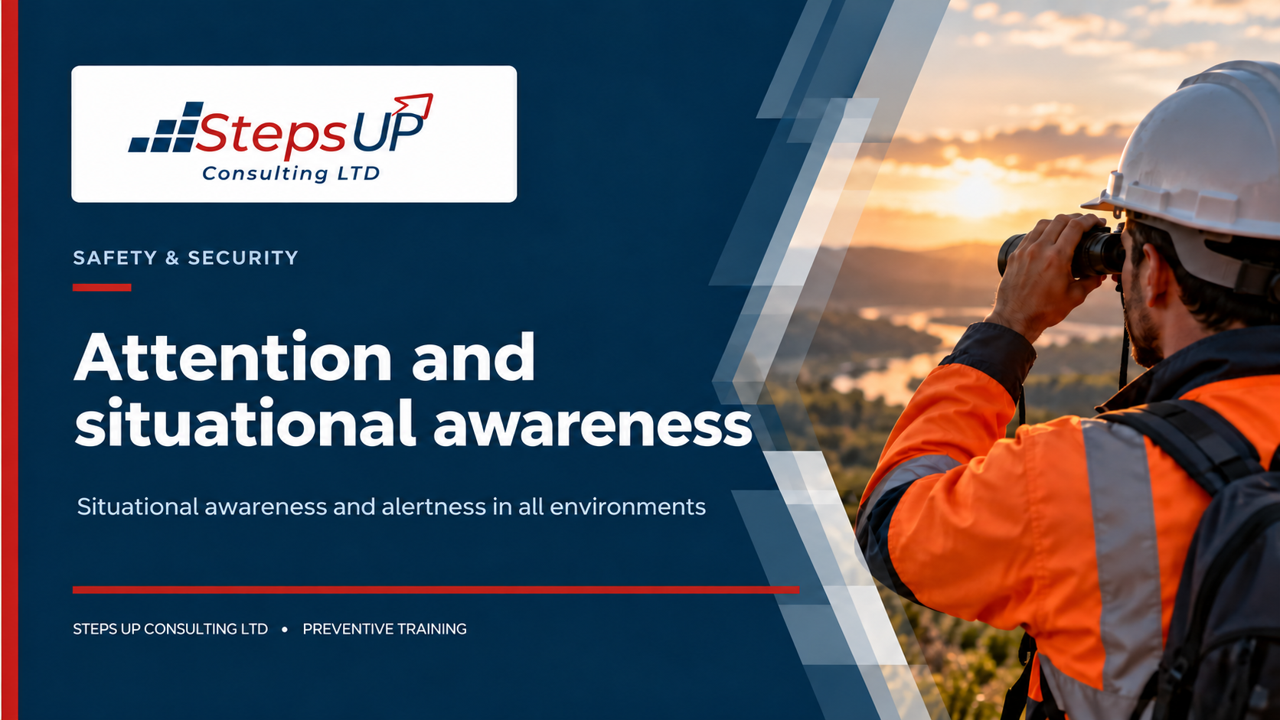
As part of our Safety & Security initiative and Safety Culture Series, we are sharing Safety Moment #4: Situational Awareness – Staying Alert in Every Environment.
This presentation covers the fundamentals of situational awareness, hazard identification, preventive measures, safe work practices, and practical applications across different environments.
StepsUP – Safety Culture Series #4: Situational Awareness
Explore our complete safety presentation and learn how to observe, understand, and anticipate hazards, strengthen environmental awareness, and apply preventive measures to create safer working conditions.
This resource can be shared during safety meetings, toolbox talks, fieldwork briefings, employee training sessions, and operational planning activities.
Building a Stronger Safety Culture Through Awareness
Safety does not depend solely on regulations, procedures, or personal protective equipment.
It also depends on our ability to recognize hazardous situations, remain alert, and act responsibly.
Risks can arise unexpectedly, but a preventive mindset allows us to anticipate changing conditions and reduce the likelihood of incidents.
Observing our surroundings, communicating hazards, and making timely decisions are essential practices that strengthen both individual and collective safety.
Observe. Understand. Anticipate. Act Safely.
At StepsUP Consulting LTD, we encourage every employee to incorporate situational awareness into their daily routines, both inside and outside the workplace.
Safe People. Stronger Places.